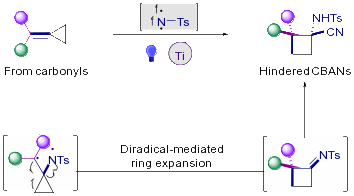
Cyclobutane amino nitriles (CBANs), as a class of sterically hindered α,α- disubstituted unnatural amino acid derivatives, have attracted extensive attention in drug discovery for their unique structural features. However, traditional synthetic strategies substantially restrict the exploration of CBANs’ chemical space, particularly for sterically more hindered vicinal tetrasubstituted derivatives. In a recent study published inNature Chemistry, a research team led by Prof. ZHANG Lumin at Shanghai Institute of Organic Chemistry (SIOC), Chinese Academy of Sciences developed a modular diastereoselective synthesis of hindered cyclobutane amino nitriles through triplet nitrene-mediated ring expansion (DOI: 10.1038/s41557-026-02156-z). This transformation involves a triplet-nitrene enabled ring expansion of alkylidenecyclopropanes (ACPs) combined with a titanium (IV) catalysed cyanylation step. Artful harnessing of the unique reactivity of triplet nitrene is the key to address the synthetic challenge. 2,2-Dialkyl-substituted alkylidenecyclopropanes (ACPs) were readily prepared from structurally diverse ketones via classical Wittig or Tebbe olefination, demonstrating the generality of this strategy. Researchers used pyridin-1-yl(tosyl)amide (Py+NTs-) as a less conventional nitrene precursor, tetrakis(9H-carbazol-9-yl) isophthalonitrile (4CzIPN) as an organic photocatalyst under visible light irradiation, in conjunction with titanium(IV) isopropoxide (Ti(Oi-Pr)4) as a Lewis catalyst, trimethylsilyl cyanide (TMSCN) as a nitrile source, and dichloromethane (DCM) as a solvent, to obtain the desired CBANs. Mechanistic experiments, along with DFT calculations, revealed that Py+NTs- forms triplet nitrene under irradiation and ACP is converted to the in situ generated cyclobutanimines intermediate via a diradical-mediated ring expansion pathway. This strategy demonstrates remarkable structural diversity and broad functional group compatibility. In addition, the diverse applications of this strategy have been explored. Researchers devised a two-step synthetic route, aimed at incorporating their bioisostere fragment, 5-amino-2-azaspiro[3.3]heptane-5-carbonitriles, into complex bioactive molecules to expand the chemical space of this valuable drug fragment. Besides the formation of gem-NHTs-CN framework, researchers examined the versatility of this diradical-mediated ring expansion gem-difunctionalization strategy with respect to various functionalized pyridinium ylides as nitrene precursors. Furthermore, researchers constructed a versatile platform by trapping the in situ generated cyclobutanimines intermediate with a wide spectrum of nucleophiles, thereby enabling the generation of structurally diverse congested motifs. They anticipate that this strategy will significantly expand the available chemical space of sterically congested CBANs and its diverse applications, which will have both synthetic and mechanistic implications. More broadly, their diverse products, which feature hindered unnatural amino acid derivatives that are rigid, sp3-rich, and three-dimensional, will attract significant attention from medicinal chemists for drug discovery. 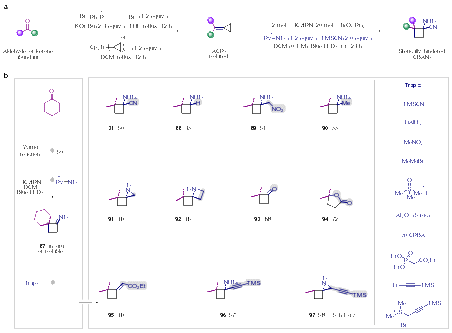
Professor Dr. ZHANG Lumin State Key Laboratory of Fluorine and Nitrogen Chemistry and Advanced Materials, Shanghai Institute of Organic Chemistry, Chinese Academy of Sciences Ling Ling Road 345 Shanghai 200032 China Tel: 0086-21-54925579 Email: zhanglm5618@sioc.ac.cn |


